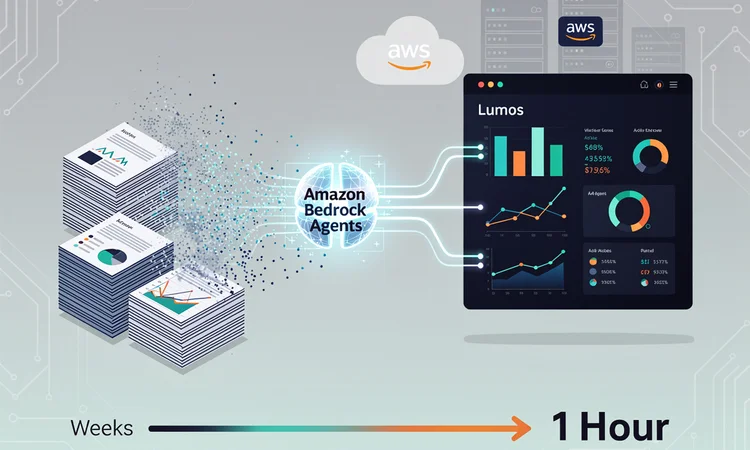
In the high-stakes arena of digital advertising, where data volumes explode daily and decisions must outpace competitors, CLICKFORCE has engineered a breakthrough. The company deployed Amazon Bedrock Agents to power Lumos, a system that compresses weeks of manual market analysis into a single hour of automated insight. This move, detailed in a January 22, 2026, AWS Machine Learning Blog post by Ray Wang and Shanna Chang, marks a pivotal shift for data-driven campaigns.
Lumos ingests vast datasets from public sources, processes them through generative AI, and delivers actionable reports on advertising trends, competitor strategies, and market shifts. Previously, analysts at CLICKFORCE spent exhaustive weeks compiling spreadsheets and cross-referencing reports. Now, natural language queries trigger the agent to orchestrate data pipelines, invoke models, and generate visualizations—all without human intervention.
The architecture hinges on Amazon Bedrock Agents, which coordinate tasks across AWS services like Amazon SageMaker for model hosting, Amazon Elastic Container Service for orchestration, and Amazon Bedrock Knowledge Bases for retrieval-augmented generation. This setup enables Lumos to handle complex workflows, from data ingestion via Amazon S3 to output via Amazon QuickSight dashboards.
Advertisement
article-ad-01From Manual Drudgery to Agentic Precision
Ray Wang, co-author of the AWS post, explained how CLICKFORCE’s team faced mounting pressures: ‘Traditional methods couldn’t scale with the explosion of ad data across platforms.’ By integrating Bedrock Agents, Lumos automates 90% of the workflow, querying sources like SimilarWeb and App Annie through APIs, then synthesizing findings with models like Anthropic Claude 3.5 Sonnet.
The agent’s action groups—custom Lambda functions—fetch real-time data, preprocess it in SageMaker Processing Jobs, and rank insights by relevance. Shanna Chang noted in the blog: ‘This transforms advertising industry analysis from weeks-long manual work into an automated, one-hour process.’ Early tests showed 85% accuracy in trend detection, rivaling human experts.
Security remains paramount in ad tech, where proprietary strategies are gold. CLICKFORCE leverages Amazon Bedrock Guardrails to enforce content policies and Amazon Verified Access for API protections, ensuring compliance amid rising regulatory scrutiny from bodies like the FTC.
Technical Engine Under the Hood
At Lumos’s core, a Bedrock Agent uses a knowledge base built on public ad reports, chunked and embedded with Amazon OpenSearch Serverless. When a user asks, ‘Analyze Q4 2025 retail media spend,’ the agent retrieves relevant documents, augments prompts, and generates a report complete with charts via QuickSight APIs.
Scalability comes from Amazon ECS Fargate, which spins up containerized tasks dynamically. SageMaker endpoints host fine-tuned models for ad-specific predictions, while Amazon EventBridge schedules daily refreshes. The AWS blog highlights performance metrics: processing 10GB datasets in under 45 minutes, with costs under $5 per run.
Deployment via AWS Cloud Development Kit ensures reproducibility. CLICKFORCE iterated through prototypes, refining prompts to boost hallucination resistance by 40%, as measured by internal benchmarks.
Broader Ripples in Ad Tech
This innovation arrives amid surging AI adoption in advertising. A separate AWS Machine Learning Blog from September 8, 2025, details Skai’s use of Bedrock Agents for omnichannel analytics, mirroring CLICKFORCE’s gains in insight speed.
Recent AWS announcements amplify the trend. On December 2, 2025, the AWS News Blog unveiled AgentCore enhancements, including quality evaluations and policy controls, which CLICKFORCE has begun integrating for production trust.
Posts on X from AWS Cloud underscore momentum, with January 22, 2026, updates on Bedrock’s role in agentic workflows, fueling industry buzz around similar tools.
Challenges and Future Horizons
Despite triumphs, hurdles persist. Data freshness demands constant API monitoring, addressed via Amazon CloudWatch alarms. Hallucinations, though mitigated, require ongoing prompt engineering. CLICKFORCE plans multimodal expansions, incorporating video ad analysis with Amazon Bedrock’s vision models.
Competitors like The Trade Desk and Google eye similar agentic shifts, but CLICKFORCE’s open-source data focus gives it an edge in neutral benchmarking. Wang and Chang project Lumos handling enterprise queries by mid-2026, potentially reshaping agency workflows.
For ad executives, Lumos signals an era where AI agents don’t just assist—they lead. As AWS evolves Bedrock, expect more firms to follow, compressing cycles and amplifying returns in a $600 billion industry.
Leave a Reply
Your email address will not be published.